The Know AML website uses a third-party service provided by Google that dynamically translates web content. Translations are machine generated, so may not be an exact or complete translation, and Know AML cannot guarantee the accuracy of translated content. Know AML and its employees will not be liable for any direct, indirect, or consequential damages (even if foreseeable) resulting from use of the Google Translate feature. For further support with Google Translate, visit Google Translate Help. The interviews webpage also uses YouTube, where subtitles and translations are generated automatically by AI; please be advised to exercise caution when precise interpretation is required. For further support with YouTube, visit YouTube Help.
What is biomarker testing, and why is its timing important in acute myeloid leukemia?
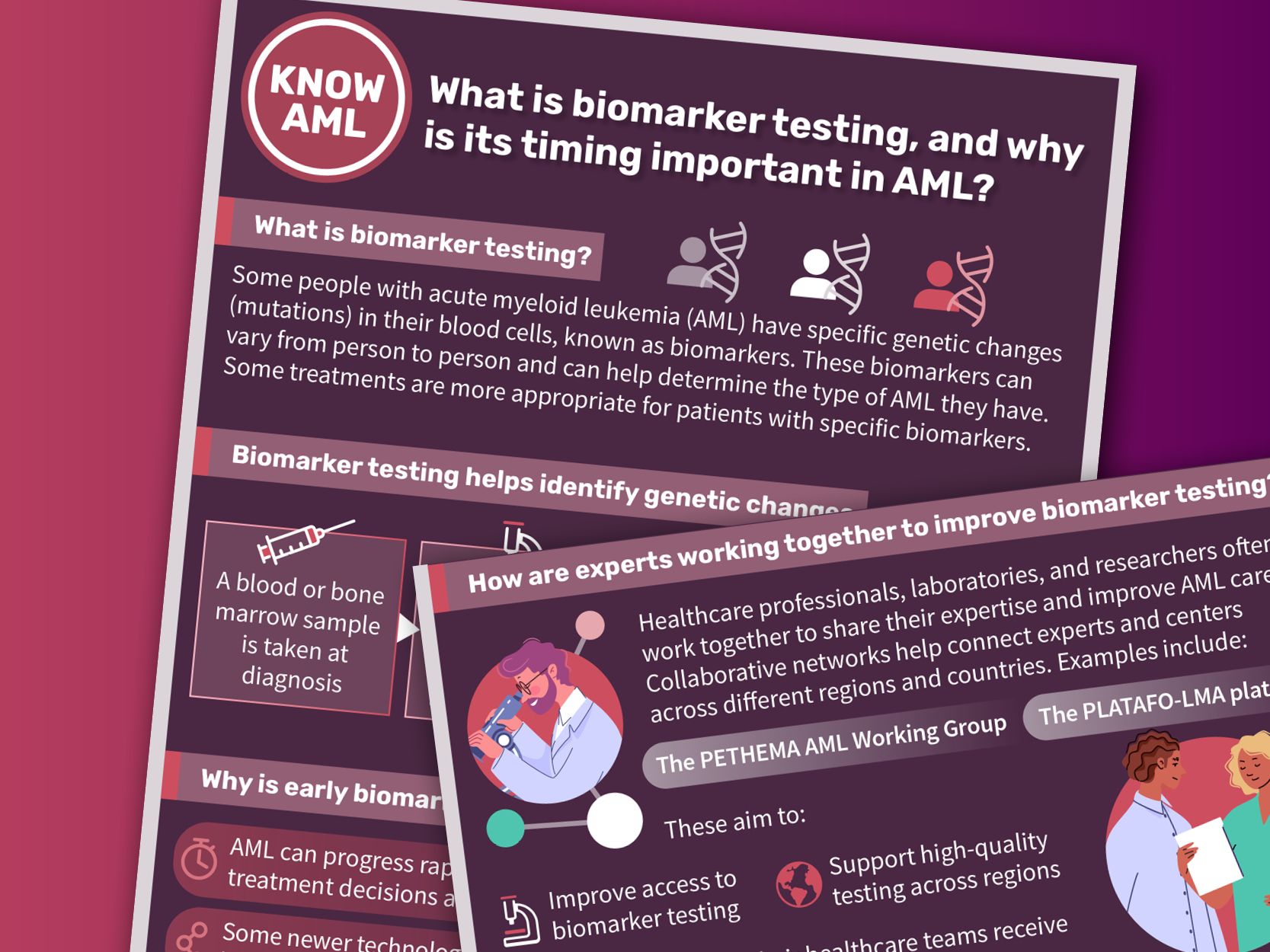
Biomarker testing looks for specific genetic changes (biomarkers) in leukemia cells. It can help doctors determine what type of acute myeloid leukemia (AML) a patient has and choose the most appropriate treatment. Because AML often needs to be treated quickly, receiving biomarker test results as soon as possible can help patients start the most appropriate treatment for their type of AML quickly after their diagnosis. Groups of experts are working together to share their expertise, improve access to biomarker testing, and enhance AML care.
Download the infographic above to learn more about biomarker testing, why its timing matters in AML, and how healthcare teams, laboratories, and researchers are working together to improve access to biomarker testing.
This educational resource is independently supported by Thermo Fisher Scientific. All content is developed by SES in collaboration with an expert ambassador group. Funders are allowed no influence.